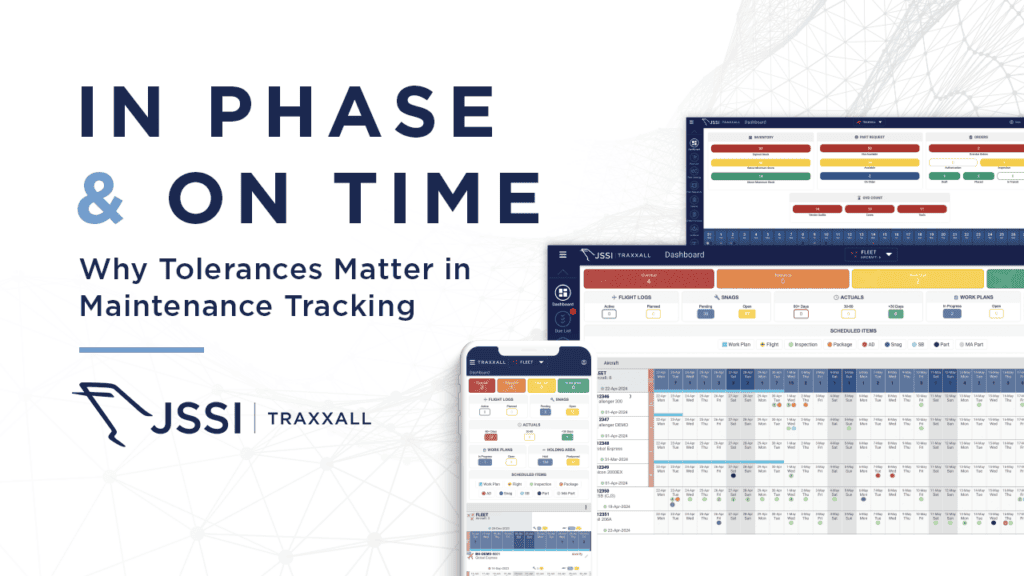
Keeping an aircraft available comes down to the timing of maintenance events, and timing is rarely perfect. That’s exactly why tolerances, sometimes called grace periods, exist. Understanding how they work, and trusting your tracking system to calculate them correctly, can be the difference between a smoothly phased maintenance event and an aircraft stuck on the ground. This page explains what tolerances are, why they matter for phasing and compliance, and how to ensure your chosen tracking system handles them correctly.
What is a “tolerance”?
A typical maintenance program is built from stacked requirements – 6/12/24/48 months, or 100/200/400/800 hours. Because the higher intervals are multiples of the lower ones, tasks are designed to line up so they can be knocked out together during a single visit. When they line up this way, they’re said to be “in phase.” Phasing is what keeps downtime to a minimum.
The problem: phasing only holds if every task is performed at exactly its due time (and in the real world, that’s nearly impossible); that’s why OEMs give operators a window. Perform a 100-hour task, with a +/- 10 hour tolerance, anywhere inside 90 to 110 hours, and it can be treated as if it were done right at 100. The next due still lands at 200, and the phasing stays intact. That window is the tolerance.
Why tolerances are worth protecting
Tolerances do more than absorb slight scheduling variances. They let maintenance managers:
- Plan shop visits around busy flight schedules instead of the other way around.
- Combine multiple due items into a single event, reducing repeated downtime.
- Move an aircraft to a proper maintenance facility on operator terms.
- Accommodate the reality of business aviation including variable utilization, international trips, and last-minute schedule changes.
In short: tolerances give flexibility without sacrificing the intent of the maintenance schedule.
The catch: tolerances aren’t “free” time
Here’s where operators get burned. Per the FAA, EASA and other regulatory authorities, inspection tolerances are not cumulative. The next due must be calculated from the previous due time, not from the point where the work actually happened. Use 10 hours of a tolerance today, and that time comes back out of the next interval. Miss this, as spreadsheets and less sophisticated solutions routinely do, and this time quietly compounds until you’ve over-flown an inspection.
How Traxxall handles the math
Traxxall was built to solve this exact problem, and it’s a major differentiator for the system:
- Every requirement carries its own independent tolerance window based on the OEM maintenance schedule or the operator’s approved maintenance program.
- The system projects the next due based on where within that window the task was actually completed.
- Traxxall preserves phasing and applies the regulatory rule that the next due is calculated from the previous due (not from the actual completion point).
The result is a tracking system operators can actually trust to keep their data clean. As one Traxxall user put it:
“This is the most complete maintenance tracking system in the industry. The software has safeguards built in so the data stays accurate. It’s also great to finally have a tracking system that tracks tolerances properly…The interface is extremely easy to use and was very easy to learn for all of our users. The dedicated analyst support is hands down better than the programs we have used in the past. The analysts actually know the aircraft and are very responsive.”
— William S., Maintenance Manager (Capterra review)
Final note
Tolerances exist to give operators flexibility without sacrificing compliance. Getting them right isn’t a nice-to-have; it’s a critical component of your aircraft’s airworthiness. And it’s exactly the kind of quiet, precise calculation that a purpose-built system should handle for you.
–
Want to confirm how your current system handles tolerances? Schedule a consultative conversation with our team to review your current process, and explore how Traxxall can help ensure accuracy moving forward.