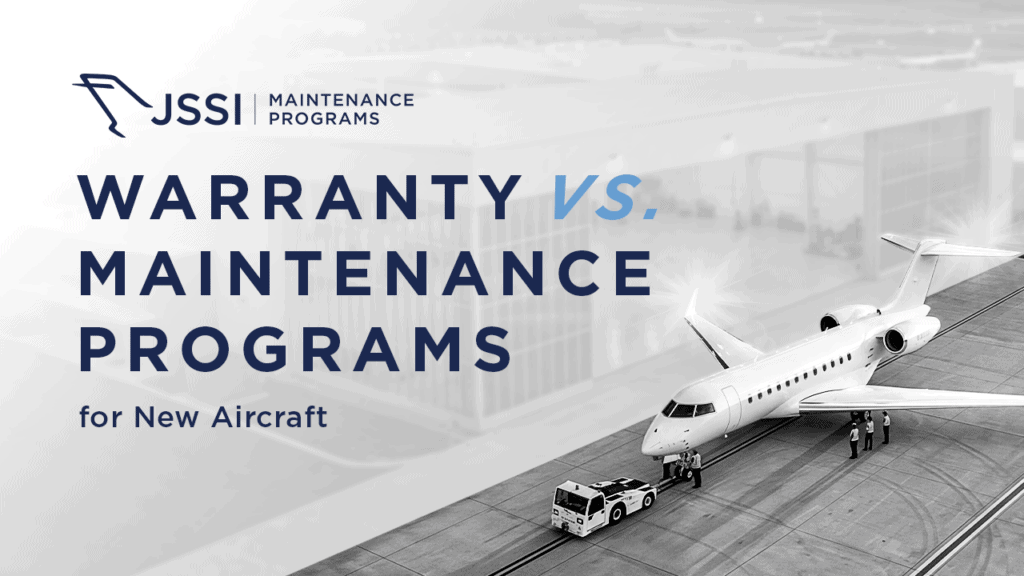
A new business jet under warranty still benefits from an hourly cost maintenance (HCM) program. The two instruments solve different problems: a warranty protects you against manufacturing defects for a limited term, while a maintenance program funds and manages the scheduled and unscheduled maintenance your aircraft will need across its entire ownership lifecycle.
The market reflects that distinction. Approximately one in five new midsize and larger business jets coming off the production line today enrolls in a Jet Support Services, Inc. (JSSI) 100% coverage program at delivery, and in certain aircraft models JSSI holds roughly one third of the market. Understanding what each instrument does, and where one ends and the other begins, is the foundation of a well-planned new aircraft delivery.
What Does an OEM Warranty Actually Cover?
A factory-new business jet does not come with one warranty. It comes with several. The airframe, engine, and APU manufacturers each warrant their own products under separate terms, and avionics and interior components often carry their own coverage as well. Each warranty has its own scope, duration, and claim process, and terms differ from one OEM to the next.
At its core, a warranty covers defects in materials and workmanship. If a component fails because of how it was built, the manufacturer repairs or replaces it, typically with OEM parts at authorized facilities. For business jets, a term of approximately five years is common, though airframe, engine, avionics, and interior warranties may run to different lengths.
Just as important is what a warranty does not cover. Scheduled maintenance and inspections, normal wear and tear, consumables, and life limited component replacement all sit outside warranty scope, as do the operational consequences of downtime, such as the cost of a rental or supplemental lift while your aircraft is in the shop. A warranty answers one question: was this a defect? Everything else in the maintenance budget remains the owner’s responsibility.
What Does an Hourly Cost Maintenance Program Cover?
An HCM program converts unpredictable maintenance costs into a stable hourly cost. For every hour flown, the owner contributes toward the maintenance events ahead, and the program covers those events when they arrive. JSSI programs span engines, airframes, and APUs, with integrated Tip-to-Tail® protection combining all three under a single contract and a single point of contact.
Program coverage reaches the categories a warranty was never designed to address: parts and labor for scheduled shop maintenance and performance restoration, scheduled and unscheduled replacement of life-limited components, repair and replacement of engine accessories and Line Replaceable Units (LRUs), labor for engine removal and reinstallation, freight, rental engines to keep you flying during shop visits, and AOG logistical support. Client maintenance reserves are held in an Independent Trust structure, protecting the funds and providing full transparency to maintenance costs.
Can You Have Both a Warranty and an HCM Program?
Yes. The two operate concurrently, and they are complementary rather than competing. A common misperception is that factory-new aircraft belong exclusively on OEM programs, or that enrolling with an independent provider somehow conflicts with warranty coverage. Neither is true. The work covered under a JSSI program is performed at the same authorized facilities, by the same technicians, as it would be under an OEM program.
Enrolling a new aircraft at delivery adds three things a warranty alone does not provide. First is warranty management: warranty events carry their own complexity, often involving the OEM, the insurance company, and the MRO, and JSSI’s technical team coordinates among those parties on the client’s behalf. Second is coverage of the gaps a warranty leaves behind, with rental engines a prime example, keeping the aircraft flying while warranty work is underway. Third is time: enrolling at delivery means funding future major events from the very first hour flown.
What Happens When the Warranty Expires?
A typical warranty term runs approximately five years. The largest maintenance events in an aircraft’s life, including major engine overhauls and life-limited component replacement, arrive well beyond it. That gap defines the real financial question of warranty-only ownership: not whether the aircraft is protected today, but whether anything is accumulating toward the events that are coming.
An owner who relies solely on the warranty reaches expiration with no reserves in place, then faces the steepest maintenance costs of the ownership lifecycle from a standing start. An owner who enrolled at delivery has contributed with every hour flown, so the aircraft arrives at its first major event fully funded. The warranty was never the plan for those events; the program is.
What Are Your Enrollment Options? 100% Coverage vs Pro-Rata
JSSI offers two coverage types, and the distinction is binary: 100% Coverage or Pro-Rata Coverage. Which one applies depends on when and how the aircraft enrolls.
100% Coverage is the path for new aircraft at delivery. It means the engine is being fully funded toward its upcoming major events, with contributions made for every hour flown, and the aircraft receives full coverage for future scheduled and unscheduled maintenance from its very first flight at their selected coverage tier. Owners of in-service aircraft can also achieve 100% coverage by paying a one-time buy-in fee that accounts for the hours already flown.
Pro-Rata Coverage is an option only for in-service enrollments. Introduced in 1989, it allows an owner to enroll an aircraft that was not previously on a program without paying a large lump sum up front to catch up on past hours. The owner pays in going forward and covers their share of scheduled maintenance based on hours already flown; enroll at 60% of the way to overhaul, for example, and the owner covers that 60% while the program covers the 40% accrued during enrollment. From the day of enrollment, Pro-Rata clients receive JSSI’s technical oversight and protection at unscheduled events, with scheduled maintenance and LRU replacement costs shared on a predictable, pro-rated basis. Clients who want full LRU coverage can add it to their coverage scope for a one-time fee.
The key question is simply when the owner pays: up front, through hourly contributions or a buy-in to 100% coverage, or later, at overhaul or resale, under Pro-Rata. For a new delivery, the answer is already made: enrolling at delivery is the only moment 100% coverage is available with no buy-in at all.
How Does Program Enrollment Affect Resale Value?
A maintenance program follows the aircraft into the transaction market: 85% of HCM contracts transfer to the buyer at sale. For a buyer, a transferred contract means the major events ahead are already funded and the maintenance history is documented and predictable. For the seller, that translates into a stronger position at exit.
The Independent Trust structure reinforces that value. Reserves contributed over the ownership period are protected and maintenance costs to date transparent.
Contact Us
JSSI is the largest independent provider of maintenance support and financial tools to the business aviation industry, supporting more than 6,500 aircraft through maintenance programs and maintenance tracking software. If you are taking delivery of a new aircraft and evaluating enrollment on programs, contact us to discuss the right coverage for your operation.

Authored by
Fabrice Roger
Executive Vice President, Business Development
Frequently Asked Questions
Do new business jets need an hourly cost maintenance program if they are still under warranty?
Yes. A warranty covers manufacturing defects for a limited term, while an HCM program funds scheduled and unscheduled maintenance across the ownership lifecycle and manages warranty events on the owner’s behalf. Approximately one in five new midsize and larger business jets enrolls in JSSI’s 100% coverage program at delivery.
What does a new aircraft manufacturer’s warranty actually cover?
A new aircraft carries separate warranties from the airframe, engine, and APU manufacturers, each covering defects in materials and workmanship under its own terms. A term of approximately five years is typical for business jets, though scope and duration vary by OEM and by component.
What does a business jet maintenance program cover that a warranty does not?
Programs cover the maintenance a warranty excludes: parts and labor for scheduled shop events and performance restoration, life-limited component replacement, LRU repair and replacement, removal and reinstallation labor, freight, rental engines, and AOG logistical support.
Can you enroll a new aircraft in an hourly cost maintenance program and keep the OEM warranty at the same time?
Yes. The two operate concurrently and are complementary. JSSI coordinates warranty management among the OEM, the insurance company, and the MRO, and covers the gaps a warranty leaves, including rental engines while warranty work is underway.
How does enrolling in a maintenance program at delivery affect an aircraft’s resale value?
Over 85% of HCM contracts transfer to the buyer at sale, a clear example to show how the funding contributed over the ownership period typically follows the aircraft. Buyers value an enrolled aircraft because its major events are funded and its maintenance history is documented.
What happens to maintenance cost exposure when the warranty expires and no program is in place?
The largest maintenance events arrive well beyond the typical five-year warranty term. An owner without a program reaches those events with no reserves accumulated, while an owner who enrolled at delivery has funded them from the first hour flown.
Does the maintenance work performed under an independent program use the same facilities and technicians as an OEM program?
Yes. Work covered under a JSSI program is performed at the same authorized facilities, by the same technicians, as it would be under an OEM program. The difference is representation: JSSI’s independent technical team represents the client at every event.