
Executive Summary: Traxxall helps operators of Bombardier Challenger and Global business jets manage the complexities of maintenance compliance through its Master Core Templates, based on the OEM maintenance scheduled, that are updated when manufacturers publish new manual revisions. The platform handles complex tolerance calculations, supports transitions between inspection programs like MPD & MRIP, and provides continuous auditing against OEM requirements. Every aircraft is backed by a team of dedicated aircraft maintenance analysts who manage enrollment, review compliance records, and provide 24/7 support. Switching platforms is a guided, five-step process rather than a project your flight department has to run alone. Traxxall supports more than 4,500 aircraft for 15,000+ users around the world.
Key Capabilities of Traxxall for Challenger & Global Jets
- Master Core Templates: OEM-based maintenance schedule templates continuously maintained by Traxxall analysts that update your aircraft status when manufacturers publish new manual revisions.
- Holding Area – For FAA Part 135 and EASA Part CAT operators, the Holding Area module allows users to analyze maintenance schedule changes, service bulletins, and airworthiness directives, and easily manage these changes at the fleet or aircraft level.
- Intelligent Tolerance Handling: Automatic calculation of due times based on both Standard and Flexible tolerance rules, ensuring compliance windows are accurately tracked.
- MRIP Transition Support: Seamless ability to switch between Manufacturer’s Recommended Inspection Program and standard inspection programs with minimal effort.
- Automatic Interval Updates: The platform automatically adjusts Threshold/Repeat intervals as compliances occur and resets cycles when new components are installed.
- Continuous Audit: Regular automated audits highlighting differences between OEM requirements and your aircraft’s tracking data.
- Expert Analyst Support & Guided Enrollment: A dedicated analyst team of A&Ps, IAs, and industry professionals manages your switch to Traxxall in five steps and remains available 24/7 after activation.
Since the early days of aviation, preventative maintenance schedules were created to ensure the safety and reliability of aircraft. Over time, the approach to creating maintenance schedules has evolved, and today all of the modern business and commercial aircraft manufacturers utilize MSG-3 (Maintenance Steering Group-3) methodology for establishing cost effective and efficient preventative maintenance schedules to ensure airworthiness and safety. MSG-3 is a task-oriented methodology used in aviation to develop scheduled maintenance programs by analyzing aircraft systems, failure modes, and structural risks.
When you crack open the maintenance manual of nearly any business aircraft, you are going to see a lot of similarities across all OEMs and models – typically a chapter-by-chapter breakdown of task codes, a description of the inspection or life limit, and the interval at which it needs to be done. At first glance, it all seems pretty simple, but when you start diving into the details of each make & model, you may find nuances and variables that can have a big impact on maintenance planning, compliance, and flight operations.
In this post, we are going to focus on some of the intricacies of the Bombardier Challenger and Global maintenance programs and how the Traxxall platform assists operators in managing their maintenance forecast, compliance & record keeping, and revisions to the OEM maintenance schedule.
Why Challenger & Global Fleets Deserve Purpose-Built Maintenance Tracking
The Challenger and Global families are among the most widely operated large-cabin business jets in the world, which means the maintenance tracking nuances described in this post affect thousands of flight departments, charter operators, and management companies every day.
Bombardier customers operate a fleet of more than 5,200 aircraft worldwide. In 2025, Bombardier delivered 157 business jets, 11 more than the prior year, and entered 2026 with a $17.5 billion backlog and guidance to deliver even more aircraft this year. In early 2025, a Challenger 3500 delivery marked Bombardier’s 1,000th super-midsize business jet, a milestone that reflects how deeply the Challenger line is embedded in corporate and charter fleets.*
That popularity has a practical consequence for maintenance teams: a large, growing, and aging installed base that spans multiple inspection programs (standard, MRIP, and utilization-based options), multiple tolerance regimes, and frequent OEM manual revisions. Tracking a Challenger or Global correctly is not just about loading a task list; it requires a platform and a team that understand how Bombardier structures its maintenance programs.
Traxxall currently supports hundreds of Bombardier Challenger and Global aircraft, including the largest operator of Global 7500s in the world.
Traxxall – Then & Now
Founded in 2014, Traxxall’s vision was an easy-to-use, modern solution for aircraft maintenance tracking, backed by expert analyst support. The founding members of the team were former Bombardier employees and had a deep understanding of the aircraft maintenance schedules, compliance, reliability, and limitations of the other maintenance tracking solutions in the industry at the time.
Today, Traxxall supports over 4,500 aircraft and 15,000+ users in 80+ countries, with a team of roughly 200 professionals, including former DOMs, IAs, Technicians, and Pilots.
Our customer base includes Fortune 500 flight departments, top 10 charter operators, and the largest operator of Bombardier Global 7500s in the world.
Challenger & Global Focused Technology
1. Master Core Templates:
Master Core Templates are OEM-based maintenance schedule templates continuously maintained by Traxxall analysts that automatically update when manufacturers publish new manual revisions. They are the backbone of the Traxxall platform and are tightly coupled to each aircraft, ensuring that your aircraft is tracking the latest requirements. (Note: if you are following a custom or approved maintenance program, we can accommodate customizations to your aircraft and hold off on pushing revisions until your program is revised.)
2. Aircraft / Task Intelligence: When we build your aircraft profile, we can leverage another level of intelligence that is built into our Master Core, which gives Traxxall the power to ensure that your aircraft has the proper task and requirements setup. Reviewing the maintenance schedule for both the Challenger & Global models, you will see a long list of tasks that have “variables” that could be based on some of the following criteria, and the system is able to determine, in many cases, what is the right tasks and requirement for your aircraft:
- Aircraft Serial Number
- Part Number
- Pre or Post Compliance of a Service Bulletin
- Task Category
- Task Inspection Program
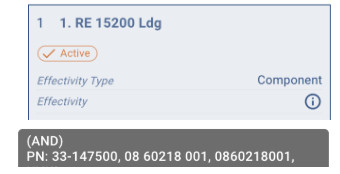
In the example below, we have a life-limited landing gear component, where you can see the requirement is applicable to the Part Numbers listed below, while hovering over the “i” button.
3. Tolerances & Flexible Tolerances: Most OEM maintenance schedules provide a tolerance or “grace period”, typically on inspection tasks, that provides the operator additional flexibility on when a task can be performed.
a. For example, a task may have a 1,000-hour interval, and a +/- 10-hour tolerance. If the task is performed inside of the tolerance window, the due time of the next inspection will not be affected. So, if the task is due at 1,000 hours and is performed at 995 hours, the due time of the next inspection should be 2000 hours. The Traxxall platform assists users in automatically calculating due times based on the tolerance rules that are in place.
b. In addition to the standard tolerances, Bombardier also has a “Flex” tolerance program which follows different rules and may have different values for tolerances at the task level. In the example below, we are looking at the Standard tolerance and Flex tolerance on a specific task. While the values for the tolerance window are different, the Flex program also provides additional flexibility when it comes to performing a task “Too Early” or before the tolerance window. For example, this task has a 36-month calendar interval:
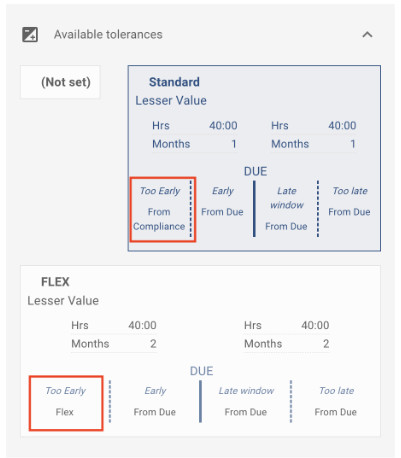
Standard Tolerance vs. Flexible Tolerance Comparison
| Feature | Standard Tolerance | Flexible Tolerance |
|---|---|---|
| Tolerance Window | Narrower (e.g., 1 month) | Wider (e.g., 2 months) |
| Early Completion Handling | Next due date resets to compliance date | Retains tolerance benefit even if completed early |
| Example: Task due 12/31/2025, completed 10/15/2025 | Next due: 10/15/2028 | Next due: 12/15/2028 |
| Operator Benefit | Basic scheduling flexibility | Better maintenance alignment and planning flexibility |
c. In both scenarios, the Traxxall platform has the power to ensure your due times are calculating correctly, and we also have the ability to easily switch between programs if needed.
d. Threshold / Repeats: Across the Challenger and Global maintenance schedules, you will find tasks with “Threshold / Repeat” intervals. For these tasks, the operator will perform the task at a certain Threshold interval, and following the compliance, the interval will then change to a different requirement.
i. In the example below, this task has a Threshold, Repeat and what Bombardier refers to as a “Next Repeat”.
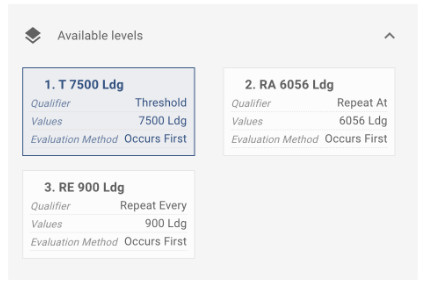
ii. How Threshold / Repeat Intervals Work:
- Step 1 – Initial Threshold: Task is first performed at 7,500 landings
- Step 2 – First Repeat: Task is performed again at 6,056 landings after the initial compliance
- Step 3 – Subsequent Repeats: Task repeats every 900 landings thereafter
iii. The Traxxall platform will automatically change these intervals as compliances occur, and if the task is associated with a component, will reset the cycle in the event a new component was installed.
4. MRIP & Multiple Inspection Programs: OEMs will sometimes have multiple options for inspection programs based on the type of operator and their aircraft utilizations.
Key Inspection Program Definitions
- MRIP (Manufacturer’s Recommended Inspection Program): A Bombardier-specific inspection program developed for low utilization operators, offering tailored maintenance intervals suited to aircraft that fly fewer hours annually.
- HUMP (High Utilization Maintenance Program): An inspection program designed for operators with high annual flight hours, featuring maintenance intervals optimized for frequently flown aircraft.
- LUMP (Low Utilization Maintenance Program): An inspection program tailored for operators with low annual flight hours, with maintenance intervals adjusted to account for time-based degradation rather than usage-based wear.
a. For Bombardier Challengers and Globals, there is an additional type of inspection program called the MRIP or Manufacturer’s Recommended Inspection Program, which was developed for low utilization operators.
b. Leveraging the Traxxall Master Cores, operators have the ability to transition between programs with minimal effort, whereas in other systems, there is much more work to manually transition aircraft between programs.
5. Continuous Audit: Leveraging the Master Core Templates and the functionality described in the sections above, Traxxall can perform regular audits of your aircraft data, highlighting any differences between the OEM requirements and your aircraft’s tracking.
The Analyst Team Behind the Platform
Software alone does not keep a Challenger or Global in compliance; people who understand the aircraft do. Every Traxxall account is supported by a team of aircraft maintenance analysts who act as an extension of your flight department, providing 24/7 system support, ongoing compliance management, and record keeping.
The analyst team is composed of A&Ps, IAs, military veterans, and industry professionals, and the broader Traxxall organization includes former Directors of Maintenance, technicians, and pilots. Analysts maintain the Master Core Templates that drive the platform, review your aircraft data against the latest OEM schedules and local-authority requirements, and answer questions with practical, regulatorily correct guidance rather than reading from a script. A dedicated training team deploys after activation, offers scheduled 1:1 sessions for recurring training and new personnel, and is backed by an integrated training module with videos and step-by-step tutorials for on-demand learning.
How We Manage Your Switch to Traxxall: 5 Simple Steps
Moving a Challenger or Global from another maintenance tracking system is a guided process led by your Traxxall Onboarding Manager. You provide the records; our analysts do the extraction, audit, and build.
- Data Collection & Review. We review your current records and reports to ensure we have all of the necessary details needed to build your aircraft into Traxxall.
- Enrollment. Utilizing proprietary technology and best practices, our analysts extract the data from your records and reports to import into the Traxxall platform. An estimated activation date is provided to your team.
- Quality Review & Audit. Your data is compared to our Master Core Templates, analyzing aircraft-specific data against the latest OEM maintenance schedules and requirements from local authorities. We compose a Quality Control Findings Report (QCFR) that identifies any discrepancies or questions based on our analyst’s review of your aircraft.
- Activation. Once the audit is complete, we activate your aircraft, and your maintenance analyst sets up an introductory call to discuss the account configuration options that work best for your operation, including varying levels of user access across your organization.
- Training. After activation, we schedule training for you and your team, building a deeper understanding of your operation and guiding you through the features and functionality of Traxxall based on your specific needs.
Once the audit is complete, we activate your aircraft, and your maintenance analyst sets up an introductory call to discuss the account configuration options that work best for your operation, including varying levels of user access across your organization.
Hear Directly from Our Customers
Recent reviews on Capterra, each rated 5 out of 5 stars, consistently point to the same three things: the depth of the analyst team, the accuracy of the data, and how quickly operators get up and running.
“What distinguishes Traxxall is the combination of an excellent product, accurate data, knowledgeable analysts, regulatory expertise, responsive customer service, rapid onboarding, and competitive pricing. After 43 years in aircraft maintenance and maintenance management, I have not used a better product. […] It is obvious that the records are being reviewed by people who understand aircraft maintenance programs and know what they are looking at. That gives me confidence in the maintenance status and data being presented by the system.”
– Greg P., Director of Maintenance, Airlines/Aviation (Capterra, September 2026)
“The interface is extremely easy to use and was very easy to learn for all of our users… The dedicated analyst support is hands down better than the programs we have used. The analysts actually know the aircraft and are very responsive.”
– William S., Maintenance Manager, Aviation & Aerospace (Capterra, July 2026)
“Six years in, the best compliment I can give Traxxall is that it quietly disappears into our day – stable, accurate, and predictable. Audits are orderly, record pulls are clean… […] The handoff is easy: their integration team pulls the history, reconciles back-to-birth, flags gaps, works with shops/OEMs, and we review; they load; we go live with clean forecasts.”
– Jonathan S., Director of Maintenance, Airlines/Aviation (Capterra, October 2025)
“Every enquiry I submit receives a prompt response, often followed by a phone call or Microsoft Teams meeting to ensure the issue is fully understood and resolved.”
– Niomi W., Part Procurement–Safety Officer, Airlines/Aviation (Capterra, July 2026)
Read more Traxxall reviews on Capterra.
Frequently Asked Questions
What is Traxxall?
Traxxall is a cloud-based aircraft maintenance tracking platform backed by expert analyst support. Founded in 2014 by former Bombardier employees and now part of JSSI, it provides operators with tools for maintenance forecasting, compliance tracking, and record keeping, currently supporting more than 4,500 aircraft and 15,000+ users in 80+ countries.
How does Traxxall handle Bombardier maintenance tolerances?
Traxxall automatically calculates due times based on both Standard and Flexible tolerance rules built into the Bombardier maintenance programs. The platform ensures accurate next-due calculations whether tasks are completed within, before, or outside tolerance windows, and can easily switch between tolerance programs as needed.
How can operators transition between MRIP and standard inspection programs?
Using Traxxall’s Master Core Templates, operators can transition between MRIP and standard inspection programs with minimal effort. The platform’s templates are designed to accommodate multiple inspection program options, eliminating the manual work typically required to switch programs in other systems.
How hard is it to switch to Traxxall from another maintenance tracking system?
Switching is a guided, five-step process led by a Traxxall Onboarding Manager: data collection and review, enrollment, quality review and audit, activation, and training. Traxxall analysts extract the data from your existing records and reports, compare it against the latest OEM maintenance schedule, and deliver a Quality Control Findings Report (QCFR) before your aircraft goes live, so your team does not have to rebuild the aircraft manually.
What support does Traxxall provide after activation?
Each account is assigned a dedicated aircraft maintenance analyst, with 24/7 system support and rapid response times. A training team provides post-activation onboarding and scheduled 1:1 sessions for recurring training and new personnel, and an integrated training module offers on-demand videos and step-by-step tutorials inside the platform.
–
If you are interested in learning more about the Traxxall platform and services and how we can help your flight operations, reach out and set up a time for a demo with one of our representatives.
Sources: Bombardier corporate boilerplate, GlobeNewswire, Sept. 21, 2026; Aviation International News, “With Bizjet Deliveries and Revenues Up, Bombardier Completes Turnaround,” Feb. 12, 2026; Bombardier press release, “Bombardier Celebrates Milestone Challenger 3500 Aircraft Delivery, the 1,000th Bombardier Super-Midsize Business Jet,” Feb. 27, 2025.